Save this article to read it later.
Find this story in your accountsSaved for Latersection.
Though they often address purposelessness, thereisa current in them that carries you towards delight and alertness.
Why did you carry that woman across the stream?
The first monk replied, Put her down.
I did two hours ago.
The stories are randomized, but the movement is always the same.
I was in the sixth grade.
I overheard Dad saying to Mother, Get ready: Wwere going to New Zealand Saturday.
I read everything I could find in the school library about New Zealand.
The project was not even mentioned, that day or any succeeding day.
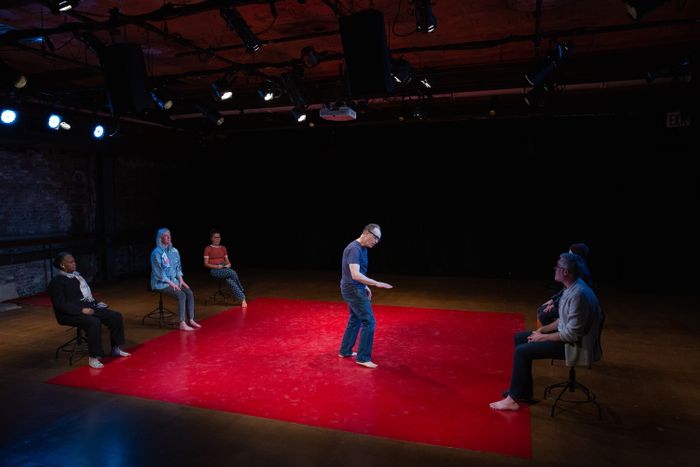
Parsons choreography, which she also performs for one sequence, underlines the texts.
Rather, I should say, the danceitalicizesthem: It emphasizes them by leaning.
As Lazar dances, even though his moves seem simple, he tuckers himself out.
Does it matter which sequence he tells the stories in?
An old rabbi in Poland or someplace thereabouts was walking in a thunderstorm from one village to another.
His health was poor.
He was blind, covered with sores.
All the afflictions of Job were his.
Stumbling over something, he fell in the mud.
Pulling himself up with difficulty, he raised his hands towards heaven and cried out, Praise God!
The Devil is on Earth and doing his work beautifully!
Cage, in recordings, was charming; Lazar, goofing around in his rolled-up jeans, issuper-charming.
Every part of his performance is suffused with the sense that hes discovering things in real time.
Is there a difference?
Cage suggests that accident and purpose arent oppositional concepts, not when everything treated with attention can instruct us.
Todays liturgy: the pleasures of meticulousness and surrender.
But dont take Lazars word for it!
Shuffle the stories again, and youll discover tomorrows liturgy for yourself.
Cage Shuffle Marathonis at La MaMa through February 19.
