The iconoclastic studio has bred superfans, dropped swag, and perfected a house style.
Its also teetering on the verge of self-parody.
Save this article to read it later.
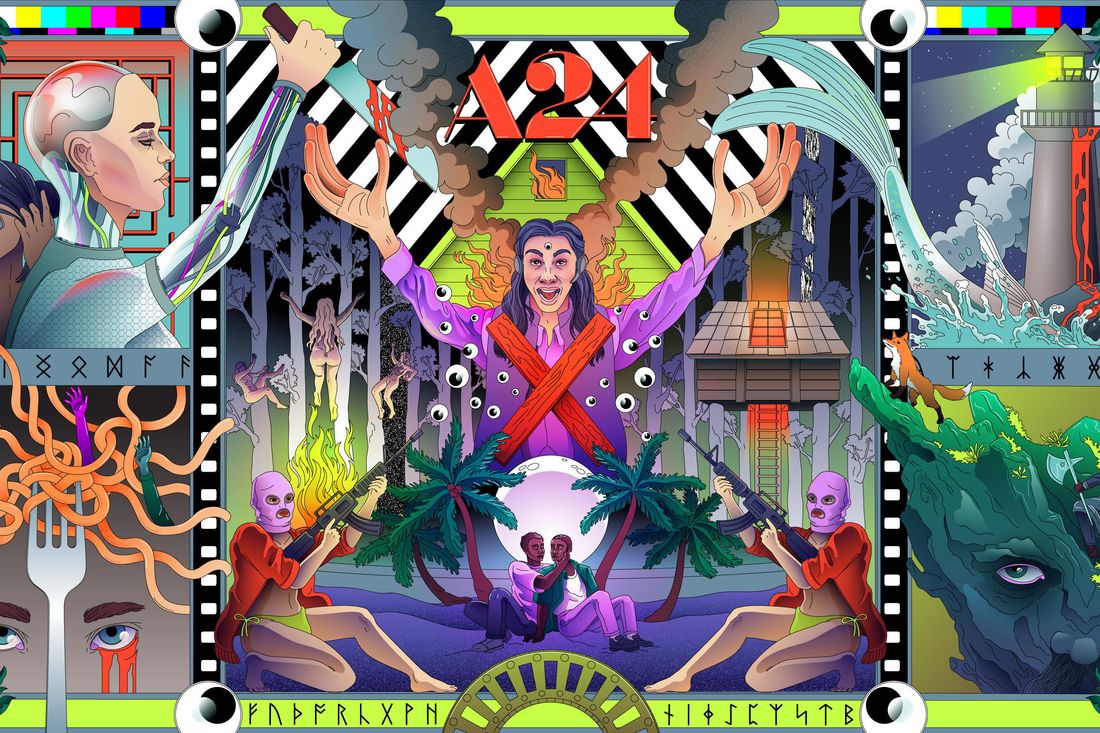
Find this story in your accountsSaved for Latersection.
House of Moods
The indie-film studio that became a lifestyle brand.
Last summer, an Austin-based graphic designer named Lauren Robinson threw herself a 24th-birthday party.
OnTikTok, where Robinson had documented the party, someone commented, Its a movie production company.
Not a personality trait.
Robinson thought they were making too big a deal: This was literally a costume party.
What drew her and her friends to A24, she says, was the rawness.
It connects with you on a personal level.
Theyre not just these feel-good, rom-com-esque movies.
Theres a deeper element.
The companys T-shirts regularly resell for more than $100 on fashion sites likeGrailed.
And in plugged-in corners of social media, the A24 superfan has become a recognizable stereotype.
Whats notable about all of this is that A24 is not a filmmaker or an arts collective.
Its an independent film studio, and studios dont usually have fans.
(All of these were acquisitions; the studio didnt begin producing its own films untilMoonlight.)
There is a certain sleight-of-hand involved, as not everything A24 has put out is great.
Not a movie but afilm.
The world of independent film is a place ambitious new companies go to die.
The start-up costs are high, the financial rewards slim.
(The seed capital was provided by Guggenheim Partners, where co-founder Daniel Katz had previously worked.)
More so than its competitors, A24 operated with one eye toward online hype.
From James FrancosLook at my shit monologue inSpring Breakers(I got shorts, every fuckin color.
I got designer T-shirts.)
Take the Daniel Radcliffe farting-corpse comedySwiss Army Man, which premiered at Sundance 2016 without distribution.
After a mixed reception at screenings, the initial offers were underwhelming.
A24 knew something everyone else didnt.
It won a Clio.)
By 2016, the studio had developed a reputation as the film-industry version of an underground record label.
You knew they were going to have a take on the artists they selected.
Most important of these was the merch.
As its standing grew, A24 merchandise became the companys most visible means of brand extension.
It could be provocative, as in the butt-plug-shaped candles it released to celebrateEverything Everywhere All at Once.
And, crucially, it could be exclusive.
And the brand began to carry legitimate cultural capital.
Now it had become sexy.
Its mood-board culture, says Curtis Everett Pawley, the other half of the duo.
If 2017 and 2018 were the spring of A24, 2019 was its high summer.
The writer Will Harrison calls it the year that memeable A24 thing crystallized, to me at least.
WithMidsommar,The Lighthouse, andUncut Gems, the studio released three viral hits within a six-month span.
And then you have COVID.
Culture was fully stagnant.
All we had was just parsing over shit and canonizing it.
AsFast Companyput it, What if Miramax, but also Supreme?
Harrison used to work at the Metrograph, and he wrotea viralBafflerstoryabout being laid off.
tilting at windmills and thinking theyre Arcteryx-sporting giants.
If A24 makes a movie, Im going to see it.
Thats how it is, she says.
A24 stands out because it isnew.
The intensity of its movies, she says, brings out her emotions in ways films never had before.
She estimates that she has seenMidsommararound 12 times, and she recently got a tattoo of Florence Pughs Dani.
(I know what its like to feel like you have no one.)
When Wallace sawEverything Everywhere All at Once,she cried through the entire movie.
Shes in the process of getting a tattoo of that one too.
In the meantime, she made herself a custom pair of Converse with the films googly-eyed motif.
Wallace is a member ofA24 All Access, or AAA24 for short.
People were going and getting, like, A24 tattoos just of the company.
Thank you for subscribing and supporting our journalism.
